
Hi Friends,
There is a slow shift that can be felt as summer slips into fall. The mornings carry a little chill, the air smells different, and the sound of leaves crunching underfoot heralds cooler winds and the scent of warm spices.
This time of the year is full of transitions. Some are big, like heading back to school or returning home from class, and others are small, like swapping iced tea for a mug of cider. Through all of it, our dogs are right beside us, steady and constant as we navigate through our days.
In this issue of Embark, you will find information on transitioning home as a newly graduated team, harness care tips, campus news, and even a recipe to bring the flavors of fall into your kitchen. We are also talking about the importance of choosing a veterinarian you can trust, a recent graduate social, and another challenging and fun word unscramble.
We are glad to share this space with you and hope it feels a little like gathering together as the days turn cooler.
The Embark Team
Below is a list of dogs who have graduated in the past months. Can you unscramble them? The answers will be towards the end of the newsletter. Have fun!

Student Campus Improvements:
New Student Lobby Flooring:
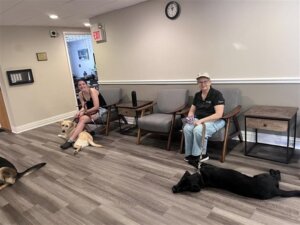
The student first floor lobby area, dorm room hallways and student coffee lounge got a refresh with new, beautiful flooring. The flooring is durable LVT (luxury vinyl tile) in a gray-blue wood grain that is slightly textured, providing better grip for our soft-pawed guide dogs. Coming soon will be new student lobby seating, furniture and photo sound panels to compliment the gathering area.
Renovations are underway of dorm rooms 3 & 4 for an updated look and featuring greater accessibility and contrast. Bathroom wall tiles include white subway tiles with black tiles providing contrast at key areas.
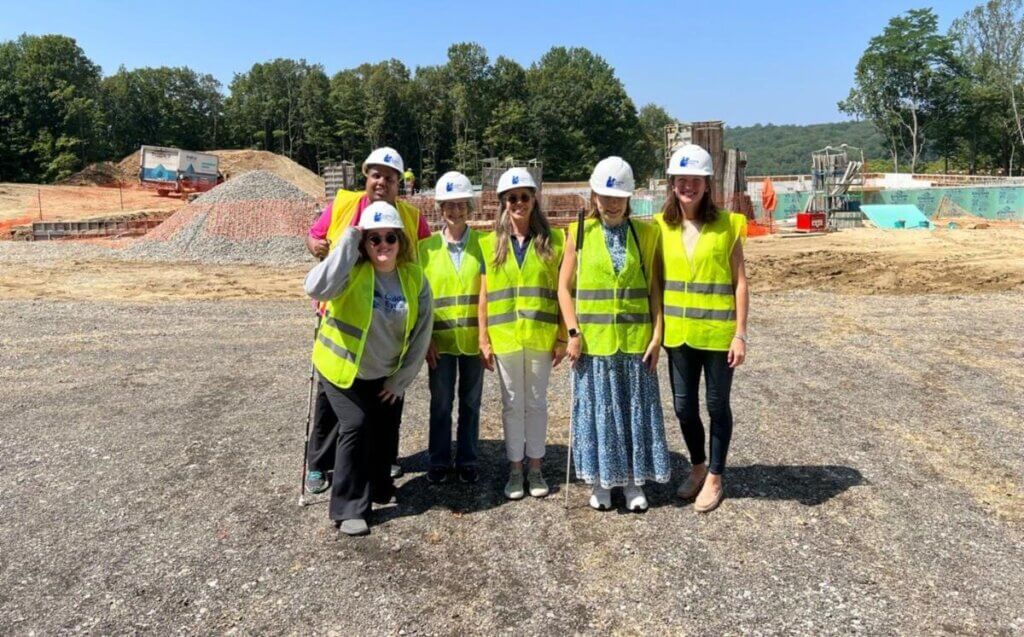
Client Experience Team Tours New Canine Wellness & Training Center Construction Site
Construction on the new Canine Wellness and Training Center is well underway! Staff members were able to visit the site in August to see the developments firsthand, including footings and the basement. We are looking forward to seeing this project continue to progress!
Returning graduate Terry McCann recently attended residential training to receive his second guide from Guiding Eyes, a male yellow lab named Army. He performed “My Guiding Eyes” during graduation and wanted to share the story behind it: I wrote these lyrics back in 2016, the night before dog day with my first guide dog. I had sat down at the grand piano in Alumni Hall, just thinking about how different life was about to be. The mix of nerves and excitement was hard to put into words, but the song came out of that moment. It was my way of capturing both the fear of the unknown and the hope of new independence, knowing that the next day I would finally meet my first guide dog. The song became a reminder that beyond the nerves and uncertainty, I was stepping into a brand-new chapter with my faithful friend — my Guiding Eyes, Mac.
You can listen to a recording of his musical performance at this link:
Terry McCann Graduation Performance
By: Placement Specialists Dan Weesner, Kat Poallo, Michelle Tang, and Shannon Deer
Transitioning home with your new guide dog is an exciting time. Your home is a place that you know very well, but your guide dog does not know at all. Your dog will look to you for guidance and structure, as you are the single thing that is familiar to them. It will be extremely important that you are consistent in what you ask of your dog and follow a routine closely. Your expectations as both a handler and caretaker must be reasonable and realistic. Below are some helpful tips to help with the transition home.
Establish a consistent routine at home so your guide dog knows what to expect. Feeding and park times should closely mimic the class schedule, especially the first few days. Give ample time in the new park area to avoid accidents.
Make sure the environment is safe and free of any objects that are hazardous or inviting but not suitable for your young guide. Have appropriate toys for them to play with, as play is a way for dogs to release stress.
Allow your guide dog to get familiar with their new home by initially keeping them on leash with you. Permit supervised freedom as they earn it- you are setting boundaries and structure for good house manners.
The first meeting with other members of the home should be calm and controlled, giving the dog a chance to settle without becoming overwhelmed. Naturally, your family will interact with the dog and form a relationship, but it’s important to remember that the guide dog is your working partner and your responsibility to care for.
When working and establishing routes at home, start with the familiar walks and then gradually reintroduce any new areas. It’s helpful to do this in short, positive sessions, so your guide dog remains confident. Make sure to give lots of support; food rewards or praise are necessary to communicate and reinforce to your dog. If there are any tricky spots, take it slow and steady. That might be a time to use your white cane, walk the route with your dog while heeling them, and target exactly what is needed without adding work pressure. It’s all about building trust and confidence in the new working environment.
Be patient with yourselves and your dog; it can take a little while to get into a groove. Mistakes are going to happen and that is a normal part of the transition. We are here to help you anytime so don’t hesitate to reach out with questions, big or small!!
By: Michael Goehring, Regional Guide Dog Mobility Instructor
Caring for your guide dog’s equipment goes a long way in keeping you and your guide dog safe, working well and professional in appearance. The equipment issued by Guiding Eyes is high quality, but it requires regular attention to stay in good condition and to perform as intended. A well-maintained harness not only looks better but also ensures you and your guide dog are working safely and effectively.
Leather Harness and Leash Care:
For traditional leather harnesses and leashes, start by wiping them down with a soft, slightly damp cloth to remove dirt, grime, and dog hair. You can use the end of your issued metal comb to remove hair from tight areas, especially near the “rabbit ears” or where pieces of leather overlap. Never soak leather in water, as this can cause it to dry out, stiffen, and crack. After cleaning, allow the harness or leash to air-dry naturally.
Pro Tip: Never dry leather near a heater or in direct sunlight—this can cause cracking and damage.
Once dry, apply a small amount of leather conditioner with a soft cloth to restore moisture and keep the leather supple. If the harness gets wet in the rain, let it dry at room temperature and then reapply conditioner.
Regular conditioning a couple times a year with a good-quality leather conditioner, such as Weiman’s 3 in 1 Leather Cleaner and Conditioner, will help prevent cracking and maintain a nice feel. Avoid products with heavy oils or waxes, as they can make the leather sticky or attract dirt. While cleaning and conditioning, check carefully for any signs of wear or damage. If something feels unusual, contact the school or your Regional Guide Dog Mobility Instructor (RGDMI). A remote video check-in can often confirm or resolve concerns.
When not in use, store your harness and leash properly by hanging in a cool, dry place out of direct sunlight. Avoid leaving them in hot cars or damp areas, as extreme heat and moisture can weaken the leather. With consistent care—cleaning, conditioning, and proper storage—your equipment will remain comfortable and reliable for years of safe travel.
Biothane Leash Care:
A Biothane leash is low-maintenance and easy to clean. For routine care, simply wipe it down with a damp cloth. For heavier dirt, wash with warm water and mild soap, then rinse well. A soft brush can be used for stubborn debris. Always let it air-dry completely before storing or using it again. Unlike leather, Biothane does not require conditioning and won’t absorb odors, making it a durable, long-lasting option. Also be sure to check that the hardware remains attached well and is working properly.
Ruffwear Collar Care:
Your Ruffwear collar is also simple to maintain. It can be hand-washed with warm water and mild soap. For heavier cleaning, it can be machine-washed on a gentle cycle inside a mesh bag.
Important: Do not put the collar in the dryer. Always air-dry only.
UniFly™ Harness Care:
The Ruffwear UniFly™ Harness is a modern alternative to the traditional leather harness. Designed for comfort and originally developed for the Guiding Eyes running guide program, it is now available to most teams, with some exceptions for safety reasons.
Maintaining a good fit requires regular checks. With moderate to heavy use, the two belly straps and two chest straps can gradually loosen. Inspect them every 4–6 weeks. The vest should fit snugly, with enough space to slide your fingers between the vest and your dog’s body—but not so loose that you can fit your fist. An improper fit can reduce the feedback you receive as well as being uncomfortable for your guide. If you’re unsure, contact the school or your RGDMI. Fit can often be confirmed over a video call.
Adjusting the UniFly Handle:
The UniFly handle includes tactile markings so you can easily remember your preferred length. Before making changes, note the current setting by counting the tactile notches located nearest the end that connects to the vest. To adjust your UniFly handle, pull the lever away from the handle until it forms an L shape. This lever is located nearest where you hold your handle. In this position, the handle can swivel 360 degrees, and the length can be adjusted.
If your Unifly handle begins to spin or change length on its own, the set screws may need tightening. A video call with your RGDMI or the Training School is strongly recommended to ensure correct adjustment.
First set screw:
Located at the top of the adjustment lever where it meets the handle. Pull the lever into an L, then locate the small hole in the corner. Insert the provided hex key and turn clockwise until snug. Do not overtighten.
Second set screw:
Located at the top of the connector piece that attaches the handle to the UniFly vest. If this loosens, it may pull you close or push you away from your guide, affecting your follow position. Tighten with the same hex key, but positioning is important.
Cleaning the UniFly Harness:
Keeping your UniFly clean is easy. Shake off loose debris, then hand-wash both the handle and vest in warm, soapy water. For spot cleaning, use a rag or soft brush (an old toothbrush works well). Rinse thoroughly and always air-dry.
The vest can also be machine-washed on a gentle cycle inside the provided mesh bag. Air-dry only. The handle should never be machine-washed. Instead, clean it by hand with a damp cloth and dry with a towel, let it air-dry fully.
With regular strap checks, occasional adjustments, and simple cleaning, your UniFly harness will remain comfortable, effective, and safe.
Quick Reference: Equipment Care
Leather Harness & Leash:
Biothane Leash:
Ruffwear Collar:
UniFly™ Harness:
By: Guiding Eyes Graduate Tina Reisner and Regional Guide Dog Mobility Instructor Mike Goehring
On August 15th and 16th, seven Guiding Eyes grads with their devoted guide dogs gathered at the Marriott in Provo, Utah for a meet and greet and mini training seminar. RGDMI Mike Goehring hosted on behalf of Guiding Eyes with active grad and former grad council member Tina Reisner assisting him in coordinating the event. On Friday night, grads and guides got acquainted with a pizza party and visited on topics shared as Guide Dog handlers. Those topics included Guiding Eyes training school updates, importance of maintaining good nutrition and health, local transportation challenges and successes, and confidence and team building. The evening was informal, providing laughter and learning.
Most of the grads stayed overnight as the Marriott Provo was kind enough to offer a significantly discounted rate. This provided additional opportunity to visit.
Over continental breakfast the following morning, RGDMI Mike lectured on distractions and how to best manage them. This was followed by a group walk in the area surrounding the hotel. The group encountered minimal natural dog distractions; however, it was a fun group outing all the same. Beyond some very practical learning, the seminar created a welcoming space for graduates to share experiences, encourage one another, and celebrate the remarkable partnerships they’ve built with their guide dogs. The event reflected not only the skills required in daily life, but also the sense of community and confidence that Guiding Eyes continues to foster.
By: Melissa Carney, Community Outreach and Graduate Support Manager
Welcome back to school! College is a time to discover yourself, your hobbies, and career path. It is packed full with new opportunities to explore, grow, and thrive, with stress and excitement as ever-present roommates. As you prepare for or are actively settling into campus life, we want to provide you with some guidance to assist in the transition with your guide dog.
1: Consider your class schedule and how your guide dog fits into your routine.
As college students, we have all made the mistake of staying up too late, hitting the snooze on our alarm too many times, and dashing to an early morning class at the speed of light to avoid embarrassment from our professor or classmates. While you might be able to pull it off, the dog cannot lie; he or she needs to use the bathroom before running anywhere. It is the handler’s responsibility to provide their guide dog with a consistent routine to relieve and eat every day. Build time into your schedule to allow for these opportunities, whether that means committing to getting up earlier in the morning, sufficient breaks between classes, or longer mealtimes for you to best accommodate. Always proactively balance your dog’s needs and your own.
2: Notify your college that you will have a guide dog on campus with you.
It is best practice to reach out to your college’s office of disability services or accessibility to let them know you will be living with and/or attending classes with your guide dog. They will guide you through the process of registering your dog with the university, and any other reasonable accommodations you may need related to your service animal. It is also beneficial to contact your professors each semester with this information, as you would with any other academic accommodations. They may assist you with seating arrangements, identifying potential relief breaks during longer classes, appropriate interactions with other students, etc. You can choose to have the initial conversation verbally but be sure to provide any accommodation requests in writing, including your guide dog, in case you experience access discrimination down the road.
3: Identify appropriate relieving areas for your dogs as well as trash cans to dispose of the waste.
Consider low-traffic areas such as patches of grass, mulch, or quiet parking lots. Avoid locations such as sidewalks, student courtyards and greens, and public gardens. The relief area should be a bit off the beaten path, but still convenient for you to access at various points of the day. If you live on a larger campus, consider identifying multiple relief areas that correspond to the campus locations you visit most frequently throughout the day, such as your dorm, dining hall, and class buildings. You can ask the college if they have a specified service animal relief area, but often these areas are unmarked. When choosing a relief area, make sure there is a trashcan nearby. While this sounds like a given, some campuses do not place outdoor trashcans in accessible locations for aesthetic reasons. The last thing you want to do is to carry your dog’s business across campus!
4: Memorize routes to key locations on your campus before introducing these routes to your dog.
While guide dogs can be skilled at integrating into college life, there is a learning curve each of them must endure. In order to set your guide dog up for the greatest amount of success, we strongly recommend learning routes with your white cane first before patterning the dog and teaching new targets. You should be familiar with the general layout of your campus, major decision points/intersections throughout, dorm, dining hall, main class buildings, and recreational areas. As a guide dog transitions to a campus environment, they thrive on your leadership, confidence level, and direction as their handler. While you are not expected to know every individual aspect of your campus, you should be comfortable building a foundation of knowledge and awareness for yourself.
5: Take the time to pattern your dog to your campus routes before classes begin.
Even if you are familiar with your routes beforehand, it is unfair to assume your dog will catch on instantaneously. Maintain realistic expectations of your dog. If you rush through the process, odds are your dog will pick up on your stress. Teach routes with an appropriate amount of patience and repetition. Be mindful of winding paths, blended curbs, and complex decision points or intersections that may take extra time to familiarize your dog with. If you are returning to school, you may find that your dog attempts to target previously visited locations. You can thank them by saying, “not now,” but encourage them to follow your directions to proceed to the new route. Be concise, positive, and patient with your directions as you target new locations or practice preexisting routes. Do not be afraid to ask for assistance from a friend, family member, or office for disability services or accessibility.
6: Be prepared to advocate for yourself when interacting with other college students and staff.
While many people are well-intentioned, you may find that certain individuals are drawn to your dog and do not realize the harm in talking to, petting, attempting to feed, or otherwise distracting them from their work. You will encounter those who have never seen a guide dog before and are unfamiliar with how to interact with or assist a guide dog team. Occasionally, one of your friends might even forget the rules. You should always educate politely, but firmly, on the tasks your dog performs, and why it is essential for them to maintain safety and accuracy through their focus on you as the handler. A guide dog can serve as a powerful social ice breaker, but also a source of curiosity. Guiding Eyes for the Blind provides informational handouts on the dos and don’ts of interacting with guide dog teams should you want to provide your college or fellow students with these materials to support your conversations and advocacy efforts.
7: Consider seating arrangements in the classroom.
While it is not always possible, try to visit your classrooms before classes begin to determine their layouts and where you would like to sit with your guide dog. From small round-table seminar spaces to large auditoriums, there are many different configurations. Safety is the priority; choose seats where your dog is unlikely to be stepped on, ideally apart from main walkways and doorways. However, you should stay closer to the front of the room and near an exit should there be an emergency in which you and your dog need to evacuate. Even if your dog is unable to fit under the seat, keep them close using a short leash tucked under your leg. Otherwise, they may attempt to visit your adoring classmates. Our Labradors and Shepherds are inherently social and would probably join every sorority on campus if they could!
8: Pack essential items for you and your dog to easily access when you are on the go.
It is best to always be prepared if your classes run late, or you do not have time to walk back to your dorm during breaks and mealtimes. Consider keeping the following items handy:
9: Consider how your travel environment may change when transitioning from home to school and vice versa.
It is quite common for a college student’s home environment to vary significantly from their campus and surrounding area. Your dog may become accustomed to these transitions, but be sure to account for any drastic changes in routine, walking routes, activity level, etc. If you have limited walking routes at home compared to your college campus, consider building more playtime into your schedule to allow for more exercise opportunities, or ask your family members to drive you into a more walkable area on a regular basis to keep your skills sharp as a team. Practice route development, street crossings, targeting, obedience, and other fundamentals of guide work. You may also find that you need to adjust your dog’s food intake slightly to accommodate your activity level. Do not let them gain the freshman fifteen!
10: Identify a safe location for your dog to blow off some steam.
Just as we need to step away from papers, study sessions, and the inevitable pop quizzes, our dogs need breaks from work as well. While they have toys in your dorm room, they cannot run far. Ask the college and fellow students if there is a safe, clean fenced off area you can utilize for play. If not, consider using a long line. You can entertain your dog with a game of fetch, recall, or other activity they enjoy. Identify an empty classroom as an alternative during inclement weather. If your dog is not playing solo, make sure you have properly introduced your guide to the other dog and always monitor for appropriate interactions and behavior.
For more training-specific advice, please visit our online class lectures, specifically Chapter 29: Campus Travel.
By: Kim Costello, Vet Hospital Administrative Assistant
Choosing a veterinarian is such an important decision for any pet owner, but it can feel even more significant when it comes to a guide dog. Your dog isn’t just a companion; they are your partner in independence. You can ask about scheduling, extended hours, wait times and payment flexibility. Have they ever worked with Guiding Eyes in the past? This can help set up direct payment. The ideal environment is calm, welcoming, and low stress. Some hospitals have access to 24-hour care while some work closely with 24-hour facilities for easy referral in case that’s ever needed. Choosing the right vet ensures your guide dog gets the care they deserve while supporting your partnership for years to come. Have a pawsome day!
As guide dog handlers, the health and well-being of our dogs is our top priority. However, there is often a significant cost associated with regular veterinary care. To help offset the financial burden, Guiding Eyes for the Blind offers three distinct funds.
Graduate Vet Assistance Fund
Guiding Eyes for the Blind graduates are eligible for $600 (subject to change yearly) each calendar year through our Graduate Vet Assistance Fund to help off-set the cost of veterinary care for working guide dogs. The fund is designated for expenses directly related to veterinary care only.
Examples include, but are not limited to:
Did you know the Graduate Vet Assistance Fund also covers pet insurance payments? Cost and coverage options vary based on you and your dog’s needs. There are often changes to what is offered and new companies pop up. The $600 Graduate Vet Assistance Fund may not cover both wellness care AND pet insurance. Pet insurance is normally used for accident and illness, not wellness, but a few companies offer add-on benefits.
The most commonly used companies include:
Be sure to do your research to determine which company offers the best plan and budget for your needs.
Examples of items not covered by the Graduate Vet Assistance Fund:
Submitting Invoices for Reimbursement:
You or your local veterinarian may submit invoices for reimbursement. Please submit itemized invoices with your name, current address, and guide dog’s name to the following:
Email: vetadmin@guidingeyes.org
Mail: Guiding Eyes for the Blind
Attention: Graduate Vet Assistance Fund
611 Granite Springs Road
Yorktown Heights, NY 10598
A check will be mailed within 2 weeks of receipt.
Gootter Veterinarian Fund
Established by long time donors, the Gootters, the new “Gootter Vet Fund” will allow Guiding Eyes graduates to collaborate with Guiding Eyes’ veterinarians and their own local veterinarians to help cover veterinary costs for minor procedures and diagnostic work. Upon pre-approval of a treatment plan and estimate reviewed by the Guiding Eyes veterinarians, the fund can cover expenses such as bloodwork, ultrasounds, and radiographs as well as minor procedures including dentistry and mass removals. This fund allows for expenditure of $1500 for a single use during the working life of a guide. This fund is dependent on availability and pre-approval by GEB vets. The ultimate goal of the fund is to return guide dogs to their work.
If you are a graduate and are interested in learning more about eligibility, please contact the Guiding Eyes Veterinary Department at
For more information on the Gootter Veterinarian Fund or to donate, please contact Rebekah Cross, Director of Donor Relations, at 914-243-2211 or
Hockmeyer Veterinary Care Fund
Another fund available to Guiding Eyes graduates is the Hockmeyer Fund. If a dog ever requires a referral to a veterinary specialist for diagnosis and treatment of a condition, this fund can help pay for the visit(s). To qualify, you must be referred to a specialist by GEB or your regular vet. If your regular vet refers you, you must contact one of the Guiding Eyes veterinarians to discuss the referral before visiting the specialist.
This fund is subject to availability and pre-approval by GEB. The care provided must have a good prognosis to return the dog to guide work. https://www.guidingeyes.org/graduate-center/graduate-funds/
In addition to these three vet funds, Guiding Eyes graduates can receive free joint health supplements for their active guides. Two joint supplements used by many veterinarians are Dasuquin and Cosequin from Nutramax Laboratories. Both work to support joint cartilage production and to protect cartilage from breakdown. Both are well-tolerated, can be given to younger and older dogs, and dogs can remain on them long-term. Nutramax Laboratories has offered to provide Dasuquin or Cosequin free of charge to any working guide dog from Guiding Eyes for the Blind. In order to receive Dasuquin or Cosequin, your veterinarian must call Sitara Costley at Nutramax Laboratories 803-313-3522(M-F8:30am-5pm {EST}) and provide some basic info about your dog. Guiding Eyes will then be contacted to confirm that your dog is an active guide from our school. Once that has been done, a 6 month supply of Dasuquin or Cosequin will be shipped directly to you or to your veterinary clinic. When you are coming close to the end of your 6 month supply please have your veterinary clinic reach out to Sitara again for a refill. Please note that you yourself should not call Nutramax about this offer. Only your dog’s veterinarian can call on your behalf. If you have any questions about the program, please contact the Guiding Eyes vet hospital at 914-243-2258.
 Mealtimes during on-campus training are a focal point for refueling, relaxing and socializing with classmates. If you’ve trained in New York over the past year, you’ve experienced the warm, welcoming and friendly atmosphere in Rosie’s Cafe brought to the table by Chef Rob, Peter, Patricio, Margaret and Jackie. As always, Chef Rob is happy to share his trade secrets.
Apple Slaw Ingredients:
Directions:
Combine all wet ingredients and mix thoroughly.
Mix in the rest of the ingredients.
Add salt and pepper to taste.
Chocolate Mousse Ingredients:
Directions:
1: In a stand mixer, or bowl with electric mixer, add 1 cup sugar, 1 pinch of salt, and 8 egg whites. Whip the mixture on medium-high until completely firm (approximately 90-120 seconds). Set the mixture aside.
2: In another bowl, combine the heavy cream and vanilla. Whip on medium-high speed until mixture is stiff (approximately 2 minutes) Try not to over whip, or the mixture may become runny.
3: Fold the heavy cream and vanilla mixture into the egg white mixture and set aside.
4: Take 2 cups semi sweet chocolate chips and, using a double boiler (one pot halfway filled with boiling water and a pot on top with the chocolate chips ), melt the chocolate and continue to stir rapidly. You can also melt the chocolate in a microwave.
Meet Placement Specialist: Dan Weesner

As a Placement Specialist, Dan works directly with students/graduates during their on-campus training at Guiding Eyes. Here’s a little bit about Dan:
How did you get into the industry?
I got into the guide dog world by accident! I was doing a college tour in high school where my family encountered a local puppy raising group. Before leaving the campus, I knew where I wanted to go to college and that we were going to be raising some puppies.
What was one of your favorite training moments in class?
Oh, my favorite moment is hard to choose but one specifically comes to mind. I was working with a first-time student, who was very nervous the first few days working with her dog. When it was time to take my support leash off, I quietly removed it for the last few blocks back to our White Plains lounge. When I told her she just did so much independently, she wrapped me in a bear hug with tears of joy! It will be one of my treasured memories of my entire career!
What is your favorite place to frequent when training with students near the White Plains lounge?
A quick Starbucks run never hurts!
If you could describe your personality in three words, what would they be?
Outgoing, rambunctious, loud
If you could instantly master any skills outside of the guide dog industry, what would it be?
I would love to master being much more handy with projects around the house. I bought a house that needed updating, and most things are way out of my league! I would love to be able to do more projects on my own
If you could only give one piece of advice to a future student, what would it be?
I always advise my students to become the teacher when they get home from class. Give yourself lots of grace, and take a deep breath. We will always be here for our graduates if they have questions when home! Plus, we love to hear how things are going!
Meet Trainee Guide Dog Trainer: Jenna Rovelli

Jenna’s interest in animal training began when she spent a semester taking a clicker-training class while earning her A.A.S. of Veterinary Science Technology at SUNY Delhi. She then decided to pursue her interest and attended SUNY Cobleskill where she earned a B.T. in Canine Training & Management. From the start she felt compelled to work in the service dog industry to use the incredible abilities of dogs to help others.
She spent four months interning with Guiding Eyes in 2022 while learning & experiencing nearly everything that goes into developing a guide dog. She spent two months working at the CDC in the Breeding & Whelping kennels and spent six weeks at the Training School shadowing and working hands on with different training teams. She loved the Guiding Eyes message, and how the employees showed a strong passion for what they did, and she felt inclined to join the team. She has now been a part of the Training Department for almost 2 years as a Trainee Guide Dog Trainer.
In her free time, Jenna enjoys reading, listening to music, and writing. She enjoys spending time with her friends, particularly when attending concerts with them. She rode horses competitively for 10+ years and hopes to someday get back into it.
The Client Experience Team has received several inquiries lately from graduates regarding how best to initiate the retirement of their guide dogs. We thought it would be helpful to provide a brief outline of the process so that you will be familiar when the time comes. For those unsure if/when the right time to retire is or just seeking general guidance, we recommend reviewing our Guide to Dog Retirement.
Once you have made the decision to retire your guide, we recommend reaching out to the Client Experience Team by calling 888-987-2188 or emailing clientexperience@guidingeyes.org
We will need you to confirm the retirement plans for your guide from the following options:
We will also need to know what date you would like to officially retire your guide. If your guide needs to return to New York for placement, we will discuss timing with you. Some of these conversations may occur with our Regional Guide Dog Mobility Instructors as well.
We are always here to support our graduates who are considering retirement of their guides. For additional guidance or peer support, do not hesitate to reach out with any questions.
Happy Birthday to the Guide Dogs that celebrated birthdays in August & September. You should have received their Annual Health Survey. Please check your email to help provide us with the very important health information.
If you have an idea or story to share for a future issue, we’d love to hear from you. While space is limited, we welcome submissions and may make edits as needed. Send your ideas to gradnewsletter@guidingeyes.org, and we’ll be in touch if we’re able to feature your piece. Thank you for being part of this journey. We can’t wait to share more with you in the seasons ahead!
Answer Key for Unscramble the Dogs: